
A reading tracker that answers the question MyAnimeList can't: where did I read this?
Next.js 16 · React 19 · TypeScript · Supabase (Postgres, Auth, RLS) · Tailwind v4 · MyAnimeList API v2
The problem
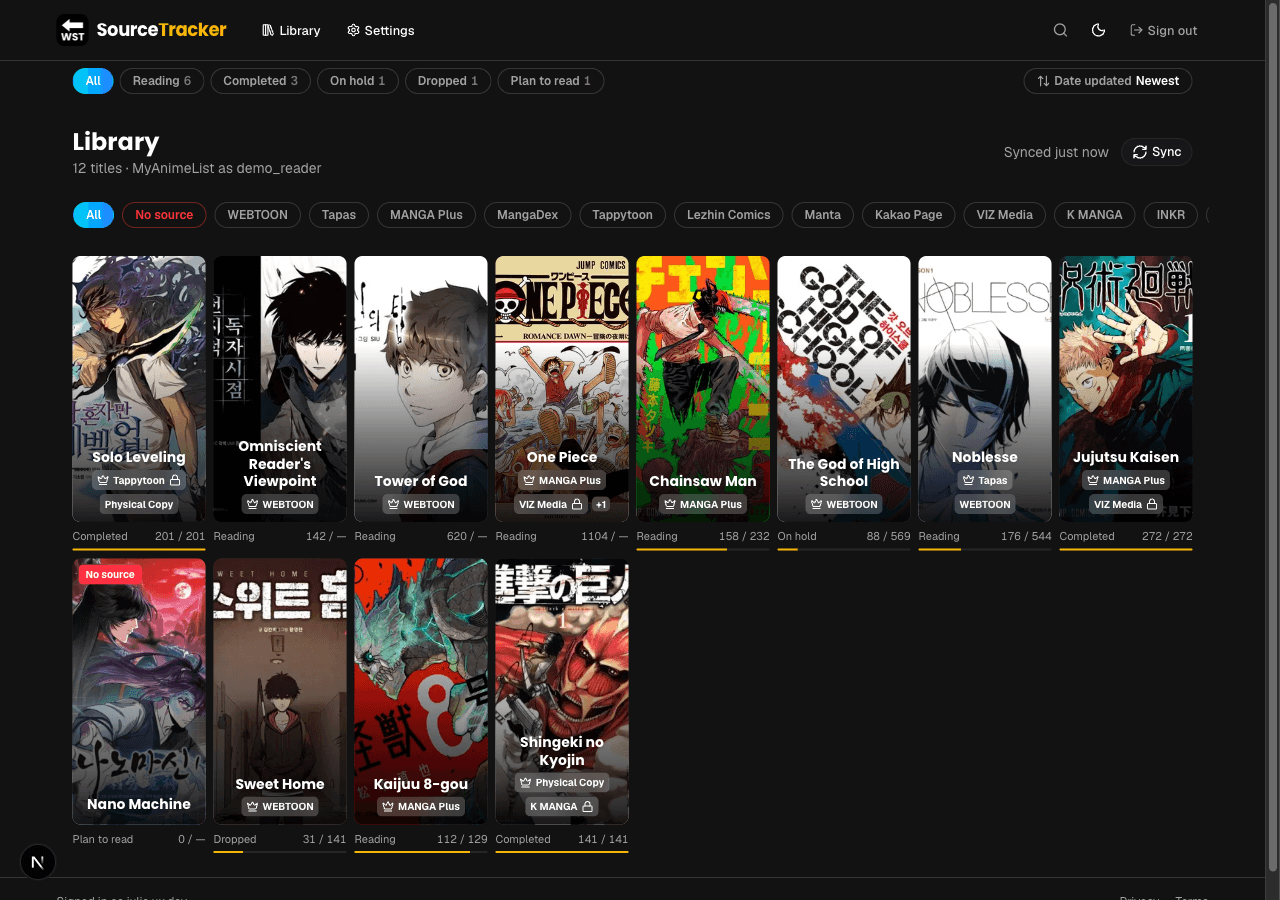
MyAnimeList is the de facto database for manga readers. It knows what you read and how far you got. It does not know that you read chapters 1–41 on WEBTOON, switched to Tapas at 42 because the official English release stalled, and own volume 1 in print.
For anyone reading webtoons that's the information that actually matters. Series migrate between platforms, licenses lapse, official releases lag scanlations by months. "Chapter 42" is useless without "on which app" — you can't resume reading from a number alone.
So the product is a thin, opinionated layer: MAL stays the source of truth for progress, and this app owns the one thing MAL will never model — the mapping from a title to the places you actually read it.
That framing drove the central architectural decision, described below.
The core decision: MAL as a connection, not a login
The obvious build is "sign in with MyAnimeList." I evaluated it and rejected it, and the reasoning is recorded in TODO.md so it doesn't get reopened.
Could it work? Partly. MAL is not an OIDC provider — all four .well-known discovery paths return 404 — so Supabase third-party auth is impossible. A custom OAuth2 provider is technically possible; Supabase has documented escapes for both blockers (pkce_enabled: false, since MAL supports only plain, and email_optional: true, since MAL returns no email).
Why I rejected it anyway: it inverts the architecture. As a login provider, Supabase would hold the MAL token, so write-back needs provider_token plumbing, and MAL becomes a login identity instead of a connection.
The user-facing consequence is the part that decided it. If MAL is your login, unlinking it locks you out of your own account, and account recovery depends on a third party that has your email for neither password reset nor verification. As a connection, you can unlink and relink freely without losing anything, and recovery works like any normal account.
The cost is a hand-rolled OAuth flow in lib/mal/oauth.ts instead of a config block. That was the right trade: the flow is ~200 lines and written once, whereas the alternative compromises account recovery permanently.
Working against an undocumented API
MAL's API v2 has real, load-bearing discrepancies between its documentation and its behavior. Each of these cost debugging time, and each is now a comment anchored at the code it constrains:
expires_in is the refresh window, not the access token's. MAL's prose says access tokens last one hour. The token response returns expires_in: 2415600 — 28 days — which is the refresh token's lifetime. Any code computing access-token expiry from that field is wrong, and wrong in a way that only surfaces an hour into a session. MalClient never inspects expiry at all; it refreshes reactively on a 401.
The refresh token rotates on every refresh. Persist only the access token and the connection dies silently about a month later, long after the deploy that caused it.
That rotation creates a concurrency bug worth calling out, because it's the kind that survives testing and fails in production:
A page that fires three server actions at once is enough to trigger it. Single- request testing never will.
Over-quota is signalled as 403, not 429. Generic retry logic treats 403 as non-retryable or lumps it with server errors and retries — the latter makes the rate limiting worse. The client surfaces it as a distinct MalRateLimitError instead.
PKCE is plain only, and PUT /manga/{id}/my_list_status is form-encoded. Both look like bugs on first read. The plain challenge especially — every instinct says to "fix" it to S256, which breaks login. It's commented in place for exactly that reason.
Data modelling: separating the catalog from the user
The first schema had one media_entries table holding both a title's identity (Solo Leveling, its cover, its chapter count) and one user's relationship to it (reading, chapter 42). Ten users tracking the same title meant ten copies of its metadata.
Table | Holds | Owned by |
|---|---|---|
| shared catalog — one row per MAL title | nobody |
| one user's progress against a title | the user |
| where that user reads it — the product | the user |
Measured on representative data, at 500 users × 300 titles this is ~58% smaller (19 MB vs 45 MB). Metadata is stored once rather than once per user, and a title's row outlives any individual user's interest in it.
The media_type column carries a check (media_type in ('manga', 'anime')) — an expansion hook for anime that v1 never writes. One column and a constraint now beats a table migration later.
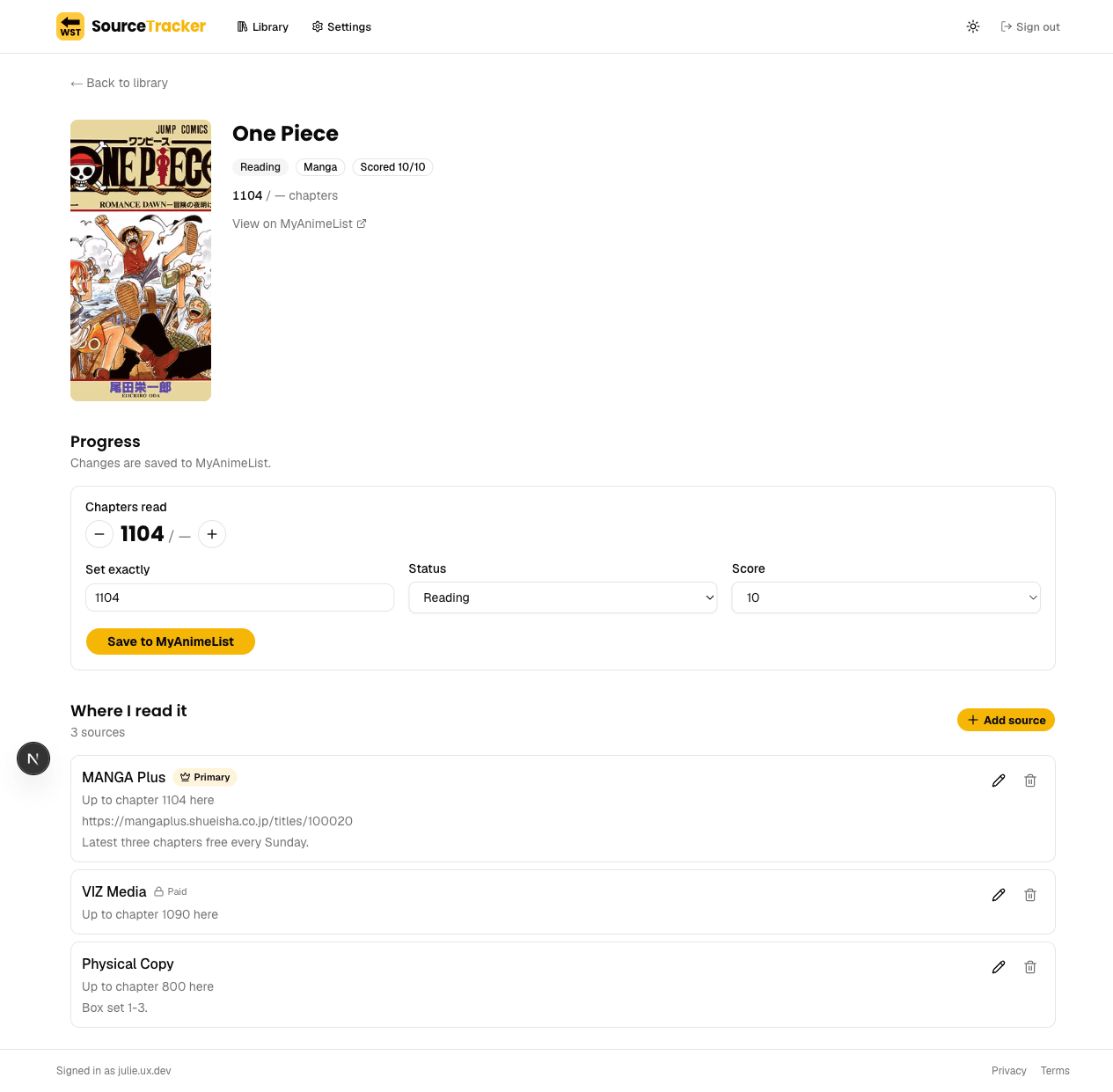
The entry view is where the model pays off — one title, three platforms, each with its own progress, URL, and notes:
Protecting the irreplaceable data
entry_sources is the only data in the app that a re-sync cannot rebuild. Every other row — titles, progress, scores — can be re-fetched from MAL. Source assignments are hand-entered, and if they're lost they're gone.
That single fact drove the most defensive code in the project. Sync deletes entries that are no longer on MAL, and that delete cascades to entry_sources. A partial MAL response — one failed page, a transient 500 — would otherwise cascade away data the user typed by hand.
So removals only run when both conditions hold:
Every page fetched cleanly, and the result exceeds half the stored count. A truncated response is non-destructive by construction.
Two smaller guards sit alongside it. An empty keepTitleIds would render not in () — invalid SQL that would delete the user's entire library — so the delete is gated on a non-empty list. And MAL can return the same title twice across pages if the list is edited mid-sync, which fails a batch upsert with cannot affect row a second time; rows are deduplicated through a Map before they're written.
Writes follow the same principle in the other direction: writes go to MAL first, and the local cache updates only from MAL's echoed response. The cache can fall behind MAL, never ahead.
I'm explicit in TODO.md that the 50% guard makes a truncated response safe but a genuine MAL-side deletion is still irreversible. The recorded fix is an archived_at column. Knowing where a mitigation stops matters more than claiming it's solved.
Auth: two layers, deliberately
Next 16 renamed middleware.ts to proxy.ts, and most Supabase tutorials still put getUser() in middleware. This app deliberately does not.
proxy.ts checks only whether a session cookie exists, to avoid flashing a protected page. It proves nothing and is not treated as if it does. Real enforcement is verifySession() in lib/auth/dal.ts, called from the authed layout, every protected page, and the top of every server action — actions are independently reachable HTTP endpoints, so a layout check does not protect them.
Two details worth the space:
verifySession() uses getClaims(), which verifies the JWT signature locally, rather than getSession(), which doesn't revalidate the token at all. And on rejection it redirects to /auth/clear-session rather than /login — the rejected cookie still exists in the browser, and only a Route Handler can delete it. Redirecting straight to /login leaves the stale cookie in place and proxy.ts keeps treating the visitor as signed in. A redirect loop that only appears with an expired session, not a missing one.
MAL OAuth state is HMAC-bound to the signed-in user. Without that binding, an attacker could complete a MAL authorization in their own browser and replay the callback against a different logged-in account, linking their MAL to someone else's profile. Verification is constant-time.
Tokens live in a private schema that PostgREST cannot reach (406 even with the secret key), accessed through SECURITY DEFINER RPCs granted only to service_role. RLS policies follow a documented set of conventions — TO authenticated rather than the deprecated auth.role(), (select auth.uid()) in a subquery so Postgres evaluates it once per statement instead of per row, and with check on every UPDATE policy, without which a user can reassign a row's user_id to someone else.
A UX bug worth the detail
Late in the build, typing in the header search interrupted itself on mobile: the keyboard closed mid-word and the grid shifted under a half-typed query.
Two causes, both downstream of search being server-driven. The input carried key={urlQuery}, so every debounced URL write remounted the focused element — and mobile browsers dismiss the keyboard along with the node it was attached to. The router.replace behind that write also re-rendered on the server, swapping the grid out from under the caret.
The fix moved the query to client state. The page already ships the whole library to the browser for the status and source chips, so filtering locally costs no extra data. A keystroke sets state, the grid re-filters in the same render, and the input is never re-created. useDeferredValue keeps the re-filter at lower priority than the keystroke so a large shelf can't stutter the field. ?q= is still written, debounced well behind typing, so a search stays linkable — but nothing on screen reads it back.
Two consequences fell out of the change, both worth noticing rather than shipping past. The title count now describes the whole shelf instead of the filtered result: a number changing under every character, inches from the field being typed in, is the same class of distraction as the moving grid. And the empty-state choice moved into the grid, since it keyed off the server's q, which is stale mid-type.
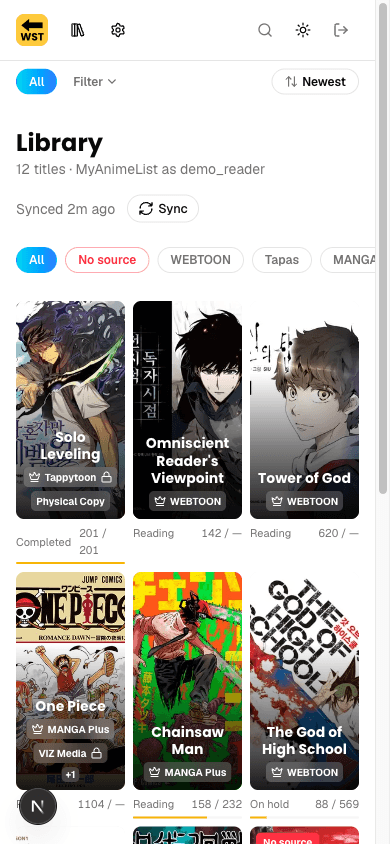
The regression test holds the DOM node across every keystroke and asserts identity — the old key shape fails it outright. Writing that test caught a second bug in the first attempt: the URL guard read window.location.search, which doesn't update until Next commits the navigation, so arriving on a shared link re-navigated to the URL it came from.
Testing what types can't catch
93 tests across 11 files, run in CI. The suite deliberately targets the gaps TypeScript and ESLint leave open rather than re-verifying what they already prove.
The clearest example is tests/rsc-boundary.test.ts. Passing a function from a Server Component to a Client Component throws at runtime — but it compiles and lints cleanly, so it reaches the browser. The test walks the source tree, resolves imports, and finds that shape statically.
The rest covers the logic where bugs are cheap to introduce and invisible to types: sync staleness, sort and filter behavior, preference resolution where a null column means "no preference" but the string 'all' means an explicit choice, and the search regression above.
Engineering practice
Comments explain why, and only where it's non-obvious. Every "this looks wrong" decision carries the reason it isn't, plus what breaks if someone "fixes" it. The plain PKCE comment exists specifically to stop a future reader from hardening it to S256 and breaking login.
Deferred work is recorded, not forgotten. TODO.md holds each deferral with enough context to pick it up cold, anchored by TODO(id) comments at the relevant code. Sign in with Apple documents the $99/yr account, the client secret that expires every 6 months with a silent failure mode, and the private-relay addresses that stop same-email auto-linking from firing. That's enough to make the decision again rather than re-research it.
Rejected options are recorded too. MAL-as-login has its own section marked evaluated and rejected, with the revisit condition stated: only if MAL ships real OIDC discovery.
Commits explain the reasoning. The search fix's message runs several paragraphs — symptom, both causes, why the chosen fix is cheap, what fell out of it, and the bug that writing the test uncovered.
What I'd do next
In priority order, from TODO.md:
archived_atonuser_entries— make sync removals recoverable. The 50% guard handles truncated responses; it does not handle a genuine deletion.Confirmation before deleting a source — currently immediate with no undo, on the one kind of data no sync can rebuild.
alert-dialog.tsxis already installed and unused; this is its natural first use.Sign in with Apple — small code change, real operational overhead.
Summary
Scope | ~9,500 lines app code, ~1,500 lines tests |
Schema | 7 migrations, RLS on every user-facing table |
Tests | 93 across 11 files, CI-enforced |
Stack | Next.js 16 App Router · React 19 · TypeScript · Supabase · Tailwind v4 · shadcn/ui |
The work I'd point at: choosing a connection model over the easier login model because of what it means for account recovery; splitting the catalog from user data for a 58% storage reduction; and treating a handful of hand-entered rows as the thing the whole sync path has to be designed around.